
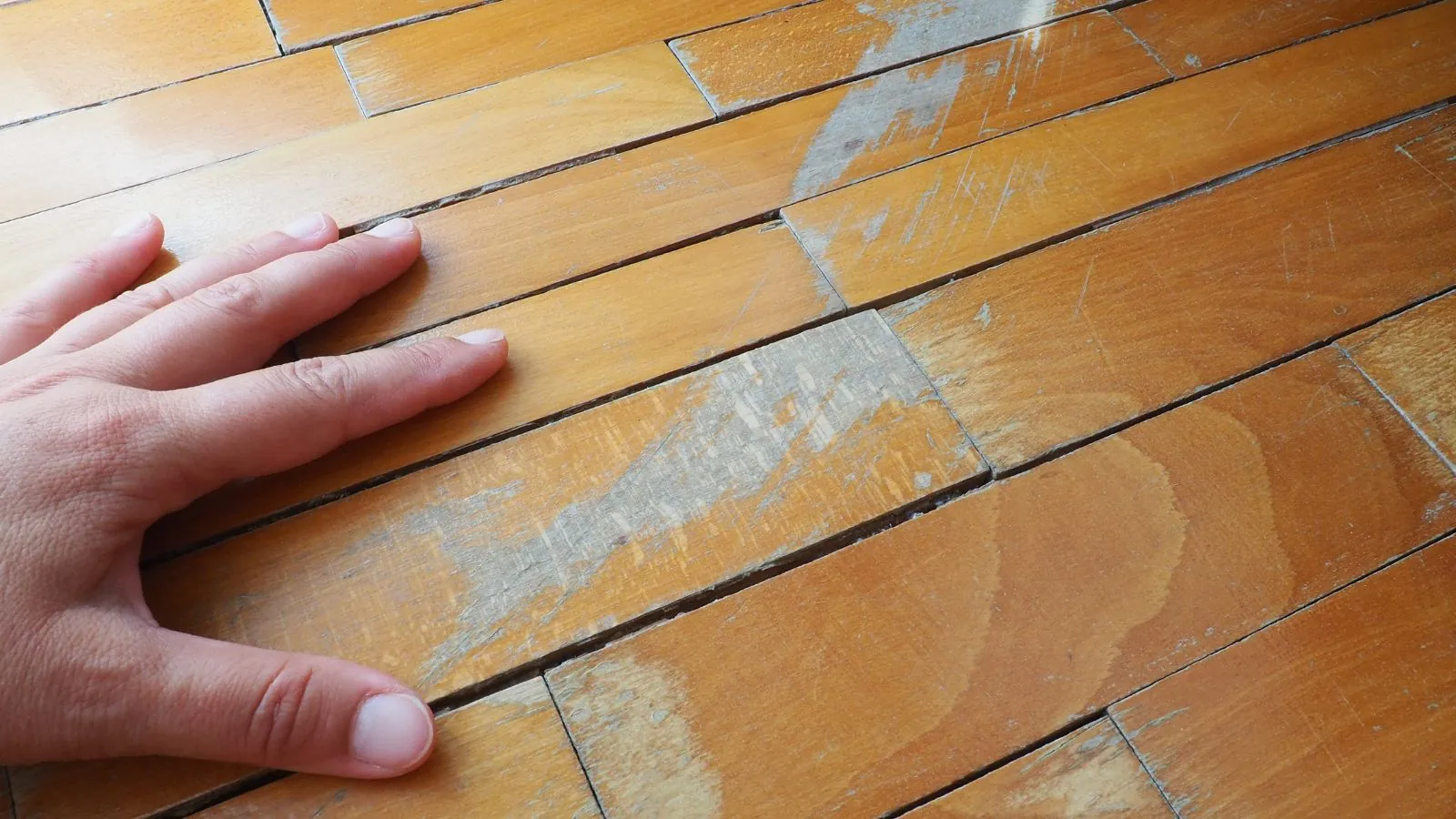
What water does to a hardwood floor
Wood absorbs water through its underside and edges first. The bottom of each board swells faster than the top, and the board curls up at the edges. That curl is called cupping. If the water stays, boards push against each other and lift off the subfloor, which is buckling.
| Sign. | What is happening. | Usual outlook. |
|---|---|---|
| Edges raised, center low (cupping). | Boards absorbed water from below. | Often flattens after drying, then sanding. |
| Boards lifting off the subfloor (buckling). | Swelling pushed boards apart from the base. | Often needs replacement of the lifted section. |
| Dark stains or black spots. | Long-term water or mold growth. | Affected boards are usually replaced. |
| Gaps between boards. | Boards dried and shrank. | Wait until fully dry, then decide on refinishing. |
Do not sand or refinish a floor until it has been dried and tested. Sanding wet cupped boards flattens them, and when they dry they dip in the middle.
First steps while you wait
- Remove standing water with towels or a wet vacuum.
- Lift rugs, furniture and wet items.
- Do not use heat to dry the floor quickly.
- Do not cover the floor with plastic or tape.
- Photograph the floor and the source.
How crews dry hardwood
Measure the moisture.
A pin or pinless meter reads the boards, and a second meter checks the subfloor.
Set floor drying mats.
Mats pull moisture from the boards and subfloor with controlled airflow.
Dehumidify the room.
A dehumidifier lowers the humidity so the wood can release water. See structural drying.
Recheck, then decide.
After several days, readings show whether boards flatten and whether any need to come up.
Hardwood is slow to dry. A rush decision usually costs more than waiting for the numbers. Drying and observing for several days often saves boards that would otherwise be pulled.
Refinish or replace
If boards have flattened and readings are normal, sanding and refinishing can restore the surface. If boards stay cupped, are stained black or are lifting, a section is replaced and blended. Solid wood sands more times than engineered wood, which has only a thin top layer, so the option depends on what you have.
Older homes in Catonsville, including many in the Old Catonsville Historic District built between 1866 and 1950, may have solid oak or pine floors that can be sanded more than once. Mention the floor type on the first call.
Finishes, glue-down floors and floating floors
How the floor is installed changes the outcome. Nailed solid boards can often be dried in place. Glued-down boards trap water against the concrete, and the adhesive can fail. Floating engineered floors swell at the edges and rarely recover once the core board is wet.
The finish also matters. A surface that is scratched or worn lets water in at the boards, while a sealed floor holds water on top until it finds the seams. Water at the seams is what runs under the boards.
Ask your installer to take readings of the subfloor before laying new boards. Installing over a damp subfloor causes cupping a few months later, and the warranty will not cover it. Keep the moisture logs from the drying work to show the floor was dry when it was closed up.
Floor drying guidance in the ANSI/IICRC S500 standard calls for monitoring moisture in the boards and the subfloor until both reach their dry standard. That is the benchmark to hold any floor contractor to.
In older neighborhoods such as Historic Catonsville, the first question is often what the floor is made of, so tell the dispatcher if you know.
Hardwood wet?
Call the 24/7 line. Early drying saves more boards.
Cost and insurance
Cost depends on the area, the drying time and whether sanding or replacement follows. Sudden, accidental discharge is generally covered for the resulting damage, but not for slow leaks. Read your policy and ask your insurer. For slab or under-floor sources, see slab leak damage. Call the line for a real number.
Common questions
Yes. The line is answered 24/7. Early drying matters because hardwood begins to cup within days. A same-day response is planned when a crew is available.
Often, if it is dried slowly and the water was clean. Sanding should wait until readings are normal.
No. Fast heat can crack boards. Controlled drying with mats and dehumidifiers is safer.
Yes. It has a thin top layer and cannot be sanded as often, so replacement is more likely.
Sudden leaks are often covered for the damage. Ask your insurer and keep photos.